
Quick Answer: In Seo vs. Google Ads roi google ads delivers visibility and traffic faster because ads appear on Google the same day after you launch a campaign. SEO takes longer because organic rankings build gradually through content, technical optimization, and authority. However, speed and ROI aren't the same. Google Ads can produce quick clicks that don't convert profitably, while SEO takes months to gain traction but delivers stronger long-term returns. The choice depends on your budget, industry, competition, and how quickly you need results.
If running a business in Kathmandu or anywhere else in Nepal and trying to decide where your next marketing rupee should go, you should probably ask yourself this exact question: SEO or Google Ads which actually pays off faster?
It's a fair question, and most articles online answer it badly. They either declare one channel "better" or bury you in generic definitions you already know. This article takes a different approach. Instead of just explaining what SEO and Google Ads are, we'll walk through the actual decision-making chain that matters to a business owner: how fast each channel gets you traffic, how much it costs to get there, how quickly that traffic turns into leads, how those leads convert into paying customers, and ultimately, what kind of ROI you can expect, both immediately and over time.
SEO vs Google Ads: What Is the Difference?
What Is SEO?
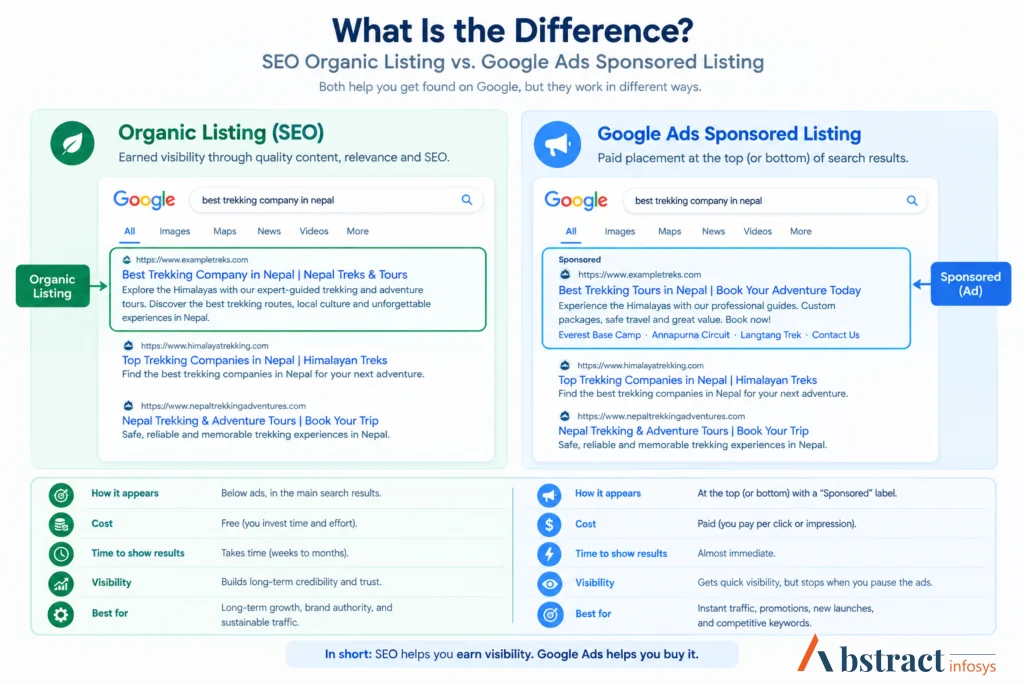
SEO (Search Engine Optimization) is the process of improving a website so it ranks higher in Google's unpaid, organic search results. It involves technical improvements to your website, high-quality content that answers what people are searching for, and building credibility (often through backlinks and consistent publishing) so Google trusts your site enough to rank it well. You don't pay Google for organic clicks; you invest in the work required to earn them.
What Are Google Ads?
Google Ads is a pay-per-click (PPC) advertising platform. You bid on keywords, and when someone searches for those terms, your ad can appear at the top of the results page, marked as "Sponsored." You pay each time someone clicks your ad, regardless of whether that click turns into a customer. The moment you stop paying, your ads stop showing.
| Factor | SEO | Google Ads |
| Traffic source | Organic (unpaid) search results | Paid, sponsored search results |
| Speed | Gradual, builds over weeks to months | Immediate, live within hours of launch |
| Cost model | Investment in content, technical work, and time | Pay-per-click (you pay per visitor) |
| Long-term visibility | Can persist without ongoing ad spend | Stops the moment you stop paying |
| Budget control | Less predictable; cost is mostly effort-based | Highly controllable daily/monthly budgets |
| Typical use case | Sustainable, long-term brand visibility | Fast visibility for promotions, launches, or testing demand |
SEO vs Google Ads ROI: Which Is Faster?
This is where most comparisons oversimplify things. "Faster" can mean four different things, and each one matters differently for ROI:
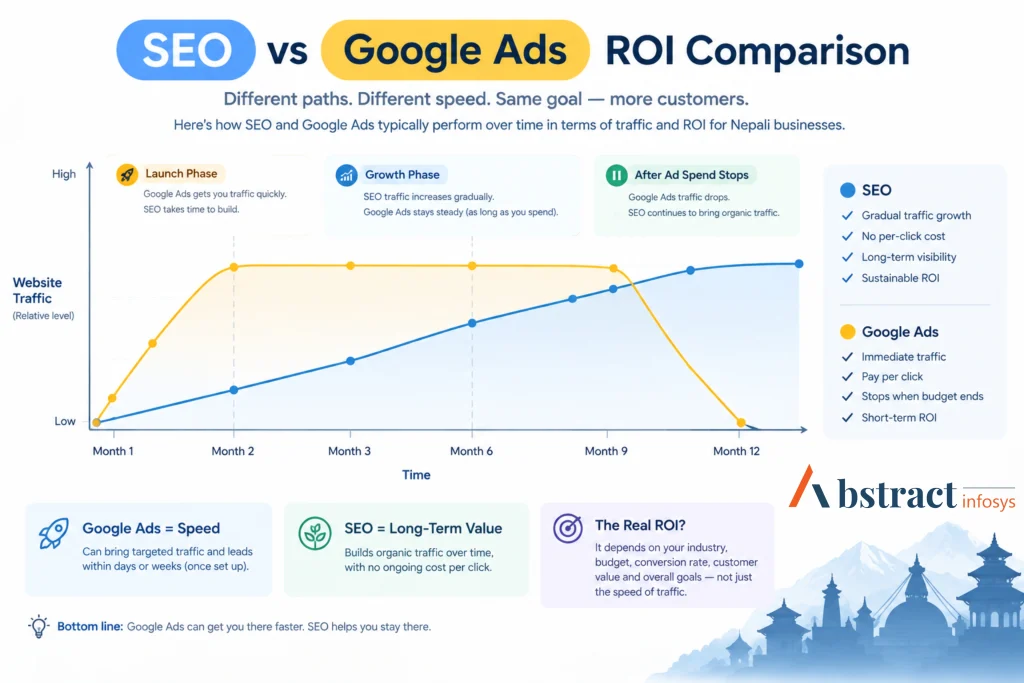
- Speed of traffic: Google Ads wins here almost every time. Once a campaign is approved, ads can start showing within hours.
- Speed of leads: This depends on the landing page, offer, and how well you've targeted the right search intent, not just on how fast the traffic arrives. A poorly optimized landing page can turn fast traffic into wasted spend.
- Speed of conversions: Even with Google Ads traffic arriving quickly, conversions depend on your offer, pricing, trust signals, and how well your website is set up to close the sale.
- Long-term ROI: This is where SEO tends to catch up and often overtakes Google Ads. Once a page ranks well, it can continue generating traffic and leads without an ongoing per-click cost, which steadily improves ROI over time.
In short: Google Ads generally wins on speed of visibility, but that doesn't automatically translate into the best SEO vs. Google Ads ROI outcome. A fast click that never converts is not a good return on anything. This is the core reason "faster" and "better ROI" need to be evaluated separately, not treated as the same question.
How Long Does SEO Take to Show ROI in Nepal?
There's no universal timeline, and any article promising a fixed number of weeks is not being realistic. SEO timelines for Nepali businesses depend on several factors:
- Competition: A local Kathmandu bakery competes for very different keywords than a national education consultancy targeting students planning to study abroad.
- Domain authority: Newer websites generally take longer to earn Google's trust than established ones.
- Website quality: Slow-loading, poorly structured sites hold back rankings regardless of content quality.
- Technical SEO: Issues like broken links, missing metadata, or poor mobile experience can quietly limit results.
- Content quality: Content that genuinely answers what searchers are looking for performs better than content written only to include keywords.
- Keyword difficulty: Highly competitive terms take longer to rank for than specific, lower-competition phrases.
- Backlinks and authority: Sites with credible links from other relevant sources tend to rank faster.
- Search demand: If very few people search for your target terms, growth will naturally look slower even with strong execution.
- Execution quality: Consistent, well-planned SEO work compounds; inconsistent or rushed efforts often stall.
Most businesses investing in SEO services in Nepal should expect a gradual build rather than an overnight shift, with meaningful movement typically becoming visible over several months of consistent work, not days.
How Quickly Can Google Ads Generate ROI?
Google Ads can start driving traffic almost immediately, but "immediate traffic" and "immediate ROI" are two different milestones. Several things determine how quickly ROI shows up:
- Campaign setup: Poorly structured campaigns waste budget before you even learn what's working.
- Keyword selection: Broad, poorly targeted keywords attract clicks from people who were never going to buy.
- Ad copy: Ads that clearly match search intent get better quality clicks, not just more clicks.
- Landing page: If your landing page doesn't build trust or make the next step obvious, paid traffic won't convert.
- Conversion tracking: Without proper tracking, you're guessing at what's actually working a common and costly mistake for Google Ads in Nepal.
- Budget: Small budgets stretched across competitive keywords limit how much data and learning you get.
- CPC (cost-per-click): Highly competitive industries can have a high cost-per-click, which directly affects how much traffic your budget can buy.
- Search intent: Ads targeting people ready to buy or book generally convert faster than ads targeting early-stage browsers.
The honest takeaway: fast clicks do not automatically mean profitable campaigns. Google Ads ROI is often visible within weeks, but only when campaigns are properly targeted, tracked, and supported by a strong landing page.
SEO vs Google Ads ROI Comparison
| Factor | SEO | Google Ads |
| Speed | Slower to build | Fast to launch |
| Initial investment | Moderate to high (content, technical work) | Can start small and scale with budget |
| Ongoing cost | Ongoing maintenance, generally lower per-visitor over time | Continuous ad spend required to sustain traffic |
| Traffic | Grows gradually, can compound | Immediate, stops when spend stops |
| Visibility | Organic listings, builds trust over time | Sponsored listings, visible immediately |
| Scalability | Scales with content and authority growth | Scales with budget, but costs rise with competition |
| Measurement | Rankings, organic traffic, conversions | Clicks, CPC, conversions, ROAS — highly measurable |
| Long-term value | Can keep delivering value with less incremental spend | Value stops once campaigns are paused |
| Local search | Strong for "near me" and location-based searches over time | Effective for immediate local visibility and promotions |
| Suitable business goals | Sustainable brand building, long-term lead generation | Quick campaigns, product launches, testing demand |
SEO vs Google Ads Cost for Nepali Businesses
Cost is where many Nepali business owners get confused, mainly because SEO and Google Ads use completely different cost models.
SEO-related costs typically include:
- Professional SEO services or an in-house specialist
- Content creation (blogs, service pages, landing pages)
- Technical improvements (site speed, mobile experience, structure)
- General website development or fixes
- Authority-building efforts such as outreach or credible mentions
Google Ads-related costs typically include:
- Actual ad spend paid to Google
- Campaign management (whether done in-house or by an agency)
- Landing page design and optimization
- Conversion tracking setup and maintenance
Which Is Suitable for Different Nepali Businesses?
| Business Type | Better Starting Point | Why |
| Travel and tourism | SEO + Google Ads together | Seasonal demand benefits from Ads, while SEO builds lasting visibility for destination and itinerary searches |
| Hotels | Google Ads for immediate bookings, SEO for sustained visibility | Ads help during peak booking windows; SEO reduces long-term dependency on paid traffic |
| Education consultancies | SEO for long-term trust, Google Ads for admission seasons | Students research extensively before choosing a consultancy — SEO builds credibility over time |
| E-commerce | Google Ads early, SEO as the store matures | Ads can generate early sales while SEO gradually reduces cost-per-acquisition |
| Local service businesses | SEO (especially local SEO) | Local searches like "near me" queries reward consistent organic presence |
| B2B companies | SEO with selective Google Ads for lead generation | Longer sales cycles benefit from organic authority and targeted campaigns |
| Startups | Depends on runway and urgency | Ads suit urgent validation needs; SEO suits businesses building for the long term |
When Should a Nepali Business Consider SEO?
- Building a brand meant to last for years, not just a campaign
- Patience to invest for several months before seeing full results
- Competitors are relatively strong in paid ads but weaker in organic content
- Want to reduce long-term dependency on advertising spend
- Business relies on consistent, repeatable search demand (like local services)
- Want to build authority and trust in a specific industry over time
When Should a Nepali Business Consider Google Ads?
- Need visibility and traffic immediately, not in a few months
- Testing a new product, service, or market and need quick feedback
- Running a time-sensitive promotion or seasonal offer
- Have a clear budget for ad spend and can track conversions properly
- Competitors are already visible at the top of paid search results
- Want tightly controlled, measurable spend tied directly to results
Can SEO and Google Ads Work Together?
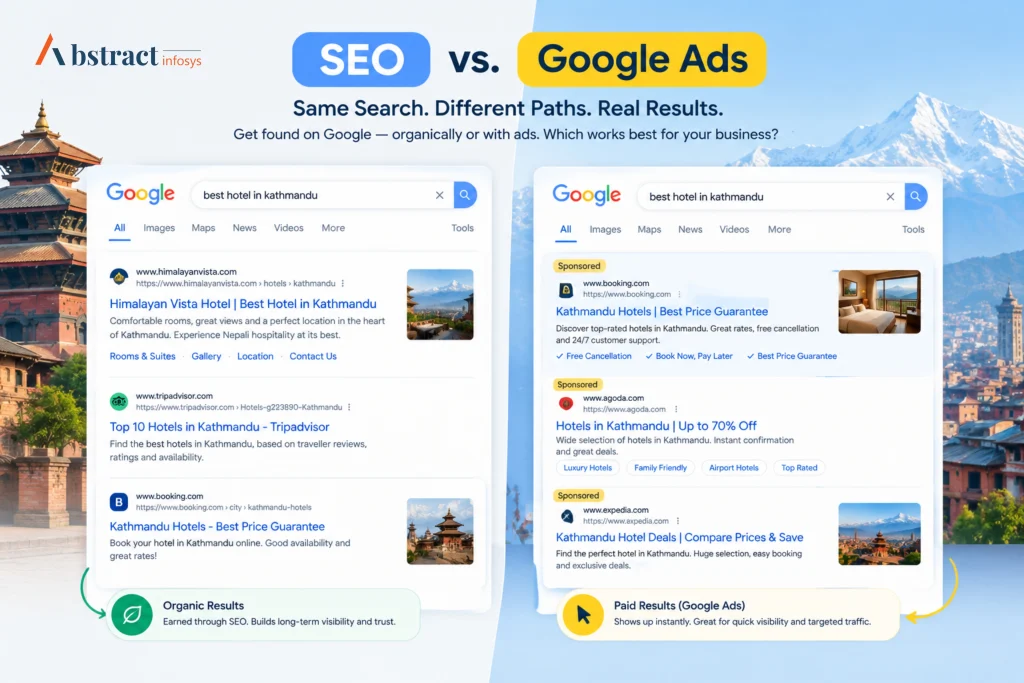
For many Nepali businesses, this combination often works better than choosing one channel exclusively. Google Ads can generate quick visibility and data while SEO is still building momentum in the background. Over time, as organic rankings improve, a business can gradually reduce its dependency on paid clicks for the same keywords, often lowering overall customer acquisition costs.
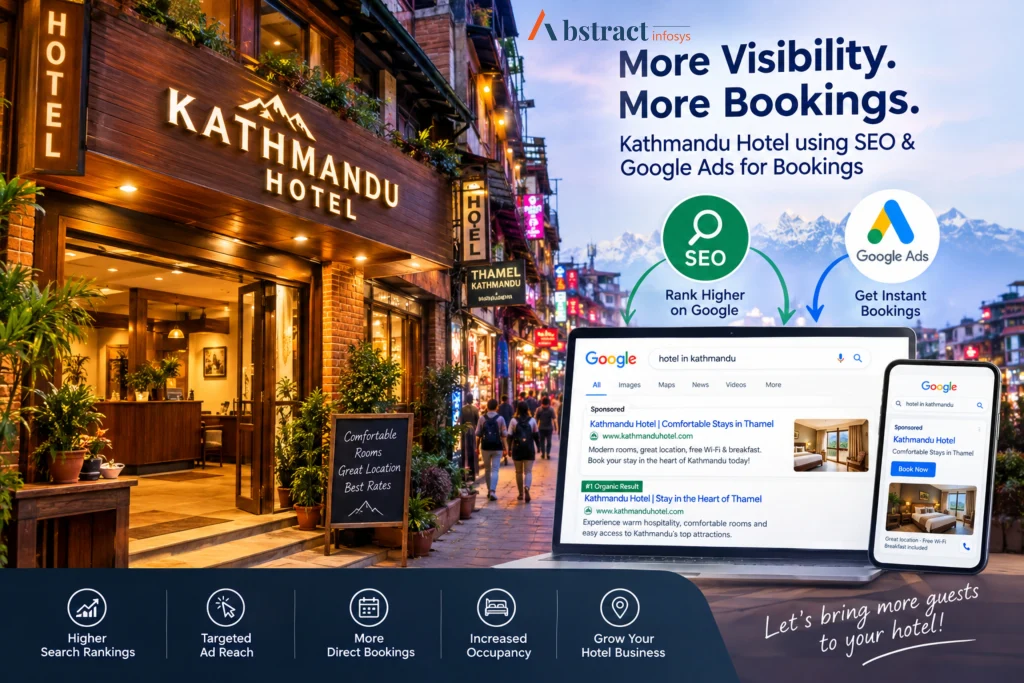
Example: Consider a Kathmandu-based hotel preparing for the tourist season. It runs Google Ads targeting "hotels in Kathmandu" and "Thamel hotel booking" to capture immediate bookings during peak months. At the same time, it invests in SEO, improving its website, publishing location- and travel-related content, and optimizing for local search. A year later, the hotel finds it's ranking organically for many of the same terms it once had to pay for, allowing it to reduce ad spend during off-peak months while still maintaining steady bookings. This is a realistic, practical picture of how SEO vs Google Ads ROI plays out when both channels are used strategically rather than in isolation.
How to Measure SEO vs Google Ads ROI
Measuring ROI properly means looking past surface-level traffic numbers and focusing on what actually affects revenue.
SEO metrics to track:
- Organic traffic
- Organic leads and conversions
- Keyword rankings
- Impressions in search results
- Conversion rate from organic visitors
- Revenue attributed to organic search
- Customer acquisition cost (CAC) from organic channels
Google Ads metrics to track:
- Impressions
- Clicks
- Click-through rate (CTR)
- Cost-per-click (CPC)
- Conversions
- Conversion rate
- Cost per conversion
- Return on ad spend (ROAS)
- Revenue generated from campaigns
The core ROI formula that applies to both channels is:
ROI = (Revenue − Marketing Cost) / Marketing Cost × 100
Traffic alone doesn't tell you whether a channel is working. A campaign or SEO strategy that brings in thousands of visitors but very few paying customers is not delivering real ROI. Actual conversions and revenue, not clicks or impressions, are what should guide your evaluation of SEO vs Google Ads ROI.
Final Thoughts
There's no definitive answer on whether SEO or Google Ads delivers better ROI. The honest answer is that it depends on business objectives, budget, search demand, competition level, conversion rate, and the lifetime value of your customers. Google Ads generally wins on speed, offering visibility and traffic within hours. SEO generally wins on sustainability, delivering stronger long-term returns once rankings are established. For many Nepali businesses, whether in travel, hospitality, education, e-commerce, or local services, the most practical path is often a combination of both, tailored to what the business actually needs right now versus where it wants to be in a year.