

A digital marketing strategy template is useful when a Nepalese business has scattered campaign ideas but no agreed way to decide what to do first. This guide turns that uncertainty into a working plan: define the commercial goal, identify the audience, select channels, assign owners, set measurement rules, and schedule improvements. It is designed for an ecommerce team choosing between SEO and paid search, a hotel trying to increase direct bookings, a local service business seeking qualified enquiries, or a startup preparing a conversion-focused website.
The important decision is not whether to use every available channel. It is which customer problem deserves investment now, which evidence will show progress, and what the business will stop doing if the evidence is weak. Treat the template as a decision system rather than a document that gets filed after a planning meeting.
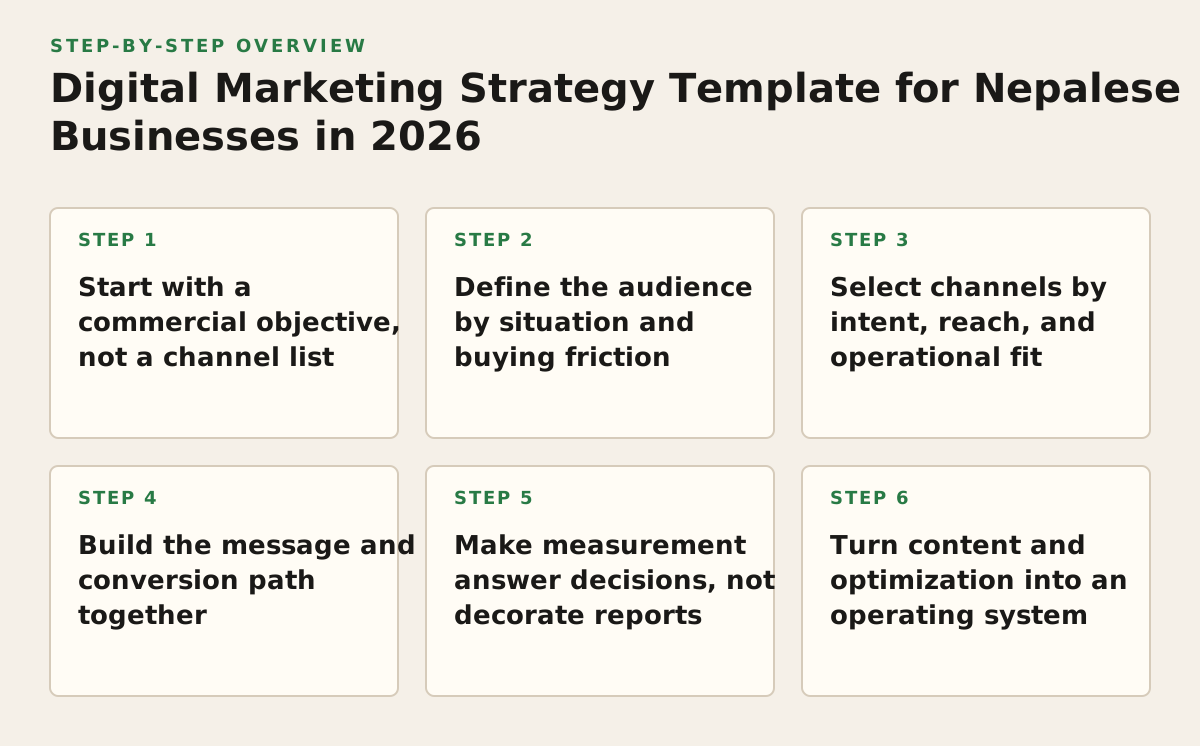
1. Start with a commercial objective, not a channel list
This principle applies when a business says it needs “more visibility,” “better social media,” or “more traffic” without defining the business result behind those requests. Channels are means; the objective determines what work is relevant. A trekking company may need qualified booking enquiries, while an online retailer may need profitable product sales and a local clinic may need calls or appointment forms.
Why it works: a measurable commercial objective creates a filter for every later choice. It helps a small team reject attractive but low-value activity, separates awareness work from conversion work, and makes agency or freelancer responsibilities easier to manage. Google’s guidance describes conversions in Google Ads as valuable customer actions such as purchases, sign-ups, or calls; use the official Google Ads conversion tracking documentation when deciding which actions deserve measurement in 2026.
Complete the objective block
- Business outcome: the result that matters, such as completed bookings, qualified leads, or profitable orders.
- Primary conversion: the action closest to revenue, such as a paid checkout or confirmed enquiry.
- Secondary conversion: an earlier signal, such as a product view, brochure download, or WhatsApp click.
- Time window: the planning period and review date. Label any duration as an internal starting policy, not a universal benchmark.
- Constraint: the limitation that affects execution, such as a small content team, seasonal demand, slow approval, or incomplete product data.
Illustrative example: a Pokhara hotel could write, “Increase qualified direct-booking enquiries from organic search and paid search during the next campaign cycle, while excluding unqualified job and partnership enquiries.” Its primary conversion might be a booking confirmation or completed enquiry form; a phone click is secondary until staff can record whether the call became a booking.
Failure mode: choosing “traffic” as the main objective when the business actually needs leads. Traffic may rise because of broad informational searches while sales staff receive no better prospects. Correct this by naming the customer action and adding a qualification field or offline status such as new, qualified, booked, or lost.
Before choosing tools or channels, use Marketing tools to support planning, execution, measurement, and optimization; the useful task is selecting a practical stack rather than collecting software for its own sake.
2. Define the audience by situation and buying friction
This principle applies when a campaign targets everyone in Nepal, “tourists,” “online shoppers,” or another broad label. Demographics alone rarely explain why someone will act. A useful audience definition describes what the person is trying to accomplish, what has prevented action, and what proof they need before contacting the business.
Why it works: audience situations determine search language, offer design, landing-page content, creative angle, and follow-up. Someone searching “family hotel near Pokhara with parking” has a different decision context from someone watching a general destination video. A B2B buyer comparing IT providers may need process clarity and response times, while a first-time ecommerce buyer may need delivery, return, and payment reassurance.
Build an audience card for each priority segment
- Situation: what triggered the search or need?
- Job to be done: what outcome must the customer achieve?
- Friction: what creates hesitation—price, trust, delivery, technical fit, language, or response speed?
- Evidence required: what would make the next step feel safe?
- Intent signal: what query, page visit, engagement, or enquiry indicates serious interest?
- Disqualifier: who should not receive the offer or be counted as a qualified lead?
Worked example: for a Nepal-based managed IT service, one audience card could describe a growing company whose owner is worried about downtime but has no internal IT manager. The job is dependable support; friction is unclear scope and fear of hidden disruption; evidence may include a transparent service outline, escalation process, and a diagnostic conversation. The campaign should not treat a student seeking troubleshooting advice as the same lead.
Map the audience to three stages:
- Problem recognition: the person notices a need and seeks education.
- Provider comparison: the person checks capability, relevance, proof, and risk.
- Action: the person requests a quote, books, purchases, or contacts the business.
Failure mode: writing one generic message for every stage. An awareness visitor may need a useful guide, while a comparison visitor needs service details and a clear next step. Create separate messages and landing-page paths, even if the underlying service is the same.
3. Select channels by intent, reach, and operational fit
This principle applies after the objective and audience are clear but the team is unsure whether to prioritize SEO, Google Ads, social media, email, partnerships, or a website improvement. Each channel solves a different part of the demand problem. Search often captures existing intent; social can create or shape interest; a website converts attention; email can nurture known contacts.
Why it works: channel selection becomes a trade-off rather than a popularity contest. Consider four dimensions: customer intent, time to useful learning, control over the destination experience, and the team’s ability to maintain the channel. SEO can build durable discovery but requires content, technical quality, and patience. Paid search can reach active demand quickly but stops when spend stops. Social distribution can show a destination or product visually but may require consistent creative production.
| Business situation | Primary channel candidate | Supporting asset | First measurement | Review decision |
|---|---|---|---|---|
| Local service needs qualified enquiries | Local SEO and high-intent search advertising | Service page with call and form tracking | Qualified enquiry rate | Improve qualification or shift spend toward converting queries |
| Ecommerce store has product demand but weak discovery | Technical SEO, category content, and product-led campaigns | Accurate product pages, feeds, delivery and return information | Revenue or qualified checkout actions | Fix product friction before expanding reach |
| Tourism business launches a seasonal offer | Search for active demand plus social creative for inspiration | Booking-focused landing page and availability process | Booking enquiry quality and completed bookings | Refresh offer, audience, or page based on objections |
| Startup has traffic but few sign-ups | Conversion optimization before adding major reach | Clear value proposition, proof, form, and follow-up workflow | Completed sign-up rate | Test message and friction points before buying more traffic |
For organic search foundations, Google Search Central’s SEO Starter Guide explains how content, crawlability, titles, links, and page experience support discoverability. Use it as a quality checklist, not as a promise that following every item guarantees rankings.
Use a channel scoring note
- Score customer intent as low, medium, or high using the audience card.
- Record whether the channel can reach the segment in the needed location and language.
- List the asset required before launch: landing page, product feed, tracking, creative, or sales workflow.
- Estimate internal effort using a clearly labeled starting policy, such as low, medium, or high effort—not an invented industry benchmark.
- Choose one primary channel and no more than two supporting channels for the first execution cycle.
Failure mode: launching five channels with no asset owner. The business then produces thin content, inconsistent offers, incomplete tracking, and slow replies. A smaller, maintained channel set is usually more useful than broad presence that cannot support the customer journey.
4. Build the message and conversion path together
This principle applies when campaigns produce clicks or social engagement but visitors do not enquire, purchase, or book. The ad, search result, post, landing page, form, and follow-up must make one coherent promise. A strong campaign cannot compensate for a confusing destination.
Why it works: consistency lowers cognitive effort. The visitor should immediately understand what is offered, whether it fits their situation, why the provider is credible, and what to do next. The conversion path should also reflect the value and risk of the decision. A high-consideration managed IT service may need a consultation; a simple product may need a direct purchase path.
Use the message-to-action sequence
- Problem: name the situation in the customer’s language.
- Promise: state the practical outcome without unsupported guarantees.
- Proof: show relevant process, credentials, examples, policies, or customer evidence that the business is permitted to use.
- Offer: explain what the visitor receives now.
- Action: use one prominent next step, with a lower-commitment alternative if appropriate.
- Follow-up: specify who responds, through which channel, and what information is captured.
Worked example: a Kathmandu web development campaign should not send every click to a generic homepage. A dedicated page could say that the service helps startups launch a conversion-focused website, show the development process, explain what information is needed for a project estimate, and use a “request a consultation” form. The related service can be represented naturally as website design and development website design and development when the reader needs a more detailed page about the delivery scope.
For accessibility planning, the W3C’s Web Accessibility Initiative introduction explains that accessibility involves websites, tools, and technologies being designed and developed so people with disabilities can use them; consult the W3C accessibility introduction when reviewing navigation, forms, text alternatives, and interaction design. This is a design responsibility, not merely a conversion tactic.
Failure mode: optimizing the landing page for clever copy while hiding practical answers. If visitors cannot find location, delivery, pricing context, service boundaries, booking availability, or response expectations, more traffic only exposes the same uncertainty. Ask sales staff for the questions they answer repeatedly and place those answers near the relevant action.
5. Make measurement answer decisions, not decorate reports
This principle applies when a team has analytics installed but cannot explain which campaigns produce useful business outcomes. Measurement should connect the customer action to a decision: increase investment, change the message, fix the page, improve lead qualification, or stop the activity.
Why it works: a small set of reliable events is easier to interpret than a dashboard full of low-value interactions. Separate business conversions from diagnostic signals. A completed booking, paid order, or qualified consultation is usually more consequential than a page view, although the latter can help diagnose where a path breaks.
Create a measurement specification before launch
- Event name: use a consistent label such as generate_lead, purchase, book_now, or phone_click.
- Trigger: define exactly what causes the event, such as a thank-you page, confirmed transaction, or tracked call.
- Source data: record campaign, medium, landing page, location, device, and product or service where appropriate.
- Quality field: add lead status or order status so volume is not mistaken for value.
- Owner: assign responsibility for checking data and acting on it.
- Decision rule: state what will change if the result is strong, weak, or inconclusive.
Google Analytics documentation describes events as interactions or occurrences measured on a website or app, including actions such as page views and purchases; the official GA4 events documentation is a suitable reference for naming and organizing measurement in a 2026 implementation.
Illustrative starting policy: review lead data weekly, but do not judge a campaign only by weekly volume if the sales cycle is longer. Mark this as a business policy and change it when the sales process provides enough outcome data. For an ecommerce store, compare product and checkout events with actual orders; for a hotel, reconcile online enquiries with booking records.
Failure mode: counting every form submission as a success. Spam, incomplete requests, job applications, and poor-fit enquiries can make a campaign look efficient. Add required fields that help qualification without creating unnecessary friction, then feed the resulting status back into planning.
6. Turn content and optimization into an operating system
This principle applies when a strategy contains good ideas but execution is irregular. Content calendars often fail because they list topics rather than customer questions, business purpose, format, owner, deadline, and reuse plan. Optimization also fails when the team changes several variables at once and cannot identify the cause.
Why it works: an operating system creates repeatable production and learning. Each asset should have a job in the funnel and a next step. One research session can produce a service page improvement, a short video, an FAQ, a social post, and sales enablement notes—but only if the central customer question is clear.
Use a practical content record
- Customer question: what uncertainty does this asset resolve?
- Intent stage: problem recognition, comparison, or action.
- Target page: where should the visitor go next?
- Evidence: what source, process detail, demonstration, or policy supports the claim?
- Format and owner: article, video, carousel, email, product copy, or landing-page section.
- Refresh trigger: seasonality, product change, search-query evidence, outdated policy, or declining qualified actions.
Worked example: an ecommerce business selling outdoor equipment can organize content around choosing gear for a Nepal trek, compare product characteristics honestly, link to relevant categories, and clarify delivery and returns. The asset should not be a generic article created only to insert keywords; it should help a real buyer move toward a suitable product.
For a search-focused improvement cycle, a business may prioritize:
- Pages already receiving relevant impressions but weak clicks.
- Important pages with indexing, speed, mobile, or navigation problems.
- Category and service pages where intent and commercial relevance are clear.
- Supporting educational content that answers objections and links logically to an offer.
Failure mode: publishing more articles while the core service or product pages remain unclear. Content can attract attention but cannot repair missing offers, weak internal linking, poor forms, or unresponsive follow-up. Fix the conversion path before scaling the publishing schedule.
When SEO execution requires specialist ownership, a business can evaluate an SEO company in Nepal SEO company in Nepal against its defined objectives, reporting requirements, technical needs, and approval process rather than selecting on promises of rankings alone.
7. Add governance, testing, and responsible automation
This principle applies when multiple people, contractors, or AI tools make changes to campaigns and websites. Without governance, tracking names drift, landing pages change without record, budgets are altered without approval, and a temporary experiment becomes permanent by accident.
Why it works: clear permissions and change records make learning safer. Define who can recommend, approve, publish, and reverse a change. Keep a short experiment log containing the hypothesis, audience, asset, date, success metric, result, and next action.
Set a minimum campaign control sheet
- Campaign objective and primary conversion.
- Target locations, audience situation, and exclusions.
- Approved message, offer, landing page, and creative versions.
- Tracking status and known data limitations.
- Budget or effort policy, labeled as an internal starting policy.
- Approval owner, launch date, review date, and rollback instruction.
Implementation plan: complete the template in sequence
Use the following sequence for a small or medium-sized Nepalese business beginning a new planning cycle in 2026. The order prevents the common mistake of buying reach before fixing the objective, destination, and measurement.
- Write the commercial brief. Record the business outcome, primary conversion, audience location, offer, constraint, and review date. If the objective cannot be connected to a customer action, rewrite it before moving on.
- Create one to three audience cards. Describe each segment’s situation, job, friction, evidence requirement, intent signal, and disqualifier. Keep segments separate when their messages or buying paths differ materially.
- Audit the destination. Check the relevant website, service, product, booking, or lead page for clarity, mobile usability, trust evidence, form friction, response expectations, and a single primary action. Fix critical path problems before expanding promotion.
- Choose the channel mix. Use the selection table to nominate one primary channel and supporting channels. Record why each channel fits the audience’s intent and what asset must exist before launch.
- Define the message. Write the problem, promise, proof, offer, action, and follow-up. Produce variants only when they test a specific assumption, such as location relevance, service angle, or customer objection.
- Specify measurement. Name events, triggers, sources, quality fields, owners, and decision rules. Test the complete journey from ad or search result through form, purchase, booking, and sales-record reconciliation.
- Launch a controlled cycle. Publish the minimum viable set of pages, ads, creative, and content needed to learn. Keep an experiment log and avoid changing targeting, offer, page, and tracking simultaneously.
- Review by decision category. Diagnose whether the problem is reach, relevance, conversion friction, lead quality, follow-up, or measurement. Each category requires a different fix; do not respond to every weak result by simply increasing spend.
- Scale only what the business can maintain. Expand budget, locations, products, or publishing frequency after the team can answer where qualified outcomes come from and who will manage the additional demand.
Abstract Infosys can help businesses combine SEO, paid advertising, social media, conversion-focused website development, and managed execution around this sequence. If the work needs an accountable planning and delivery partner, explore Abstract Infosys and bring the completed objective, audience cards, channel decision, and measurement specification to the discussion.